How to make Money in the Stock Market.This blog looks at how you can make money trading and investing in Forex, Stocks Options and Futures.

Google
Showing posts with label Commodities. Show all posts

Friday, 9 May 2008

The growing Food Crisis -what should I invest in

Around the world, rising food prices have made basic staples like rice and corn unaffordable for many people, pushing the worlds poor in places such as Africa and Asia to breaking point. It is incredible listening to the news these days to hear the headlines about Global Food Shortages and riots in countries like Haiti  and Mexico. We have become so used to the availability of food in our stores that it is sometimes easy to forget that for some people it is not just a case of heading to the nearest store to get food for their table.For some it is a matter of life and death to be able to get staple items such as wheat and rice.

It has become such a problem that some of the worlds governments have had to step in to try to protect the stock that they hold.Just yesterday India placed a ban on futures trading in several commodities, including soybean oil, chickpeas and potatoes.This was an attempt to preserve supplies and keep down the rampant inflation that is being caused by the increase in food prices.

800px-Tranplant-rice-tahilandIn Asia the problem is just as acute with rice continuing to make new highs on world exchanges.The demand placed on the prices of rice due to the huge populations of China and India has seen it reach astronomical levels with the price more than doubling in the last year.

As well as the impact on populations desperate to feed themselves, we are seeing the impact on countries as farmers try to capitalise on the current high prices by seeking land wherever they can to grow the crops that are being demanded across the globe.

Until the end of the last century, soybeans were practically unknown in the Amazon basin. It was not until the grain terminal was built that soybean farmers came to the region from farther south. The land there was cheaper, the banks were offering low-interest loans and sales were guaranteed.

Villages, rubber plantations and grazing land for cattle were transformed into bean fields. The farmers cut enormous swathes into the rainforest, until environmentalists put a temporary stop to the unchecked rash of clearcutting. In Mato Grosso, the most important farming region, producers and environmental activists agreed on a two-year moratorium on the purchase of soybeans from the Amazon basin.

From the Río de la Plata to the Amazon, the Chinese are sucking the markets for soybeans dry. Large segments of the state of Mato Grosso are already covered with a green, pesticide-drenched monoculture. In the dry season between August and November, a cloud of smoke descends on Cuiabá, the capital of Mato Grosso. Despite a government ban, many farmers burn down sections of the rainforest to gain more farmland.

In Brazil we see huge swathes of land being used to grow Soybeans to satisfy the demand from ChinaBrazil Soybeans .Brazil is one of China's major trading partners. Long-term contracts between the two countries are intended to secure raw materials for China -- and, more recently, food products in particular.

This rising world power, with its population of 1.3 billion, must take steps to ensure that it too does not become a victim of the Food Crisis .However it has a competitor on the horizon.India home to 1.1 billion people, has caught up with China in terms of the power it wields as a massive market. Together, the two Asian nations must feed more than a third of the world's population. In times of exploding food prices, their sheer size alone makes the crisis even worse.

It isn't difficult to imagine what happens to prices when the world's two most populous countries buy up other food products in a similarly aggressive fashion. In more and more dangerously poor countries, wheat and meat have become an almost unaffordable luxury, while famine and hunger riots are only likely to get worse.

Over the next few years I can only see these challenges becoming worse and prices continuing to rise.

In order to invest in these commodities we need to look once again at our favoured ETFs, I have a position in DBA the Powershares Agriculture Fund.You could also look at the AIGG Grains ETF (AIGC) or the individual ETFS for Soybeans (SOYB) or Wheat (WEAT).

There is likely to be volatility in  these markets so I would not bethinking short term and I will place stop losses of around 20% on any positions that I have or buy in to. Over a 3-5 year period I think these holdings will do very well.


Best Wishes


Alan


Thursday, 8 May 2008

The Case for $200 Oil

On Tuesday I wrote a post about the prediction from a Goldman Sachs Analyst that Crude Oil could hit $200 a barrel, $200 Crude Oil-surely not ? today I want to spend a bit more time looking at some of the reasons why that is not a crazy prediction and may even be on the low side.

The world’s known supply of crude oil has decreased by about 13% since 2001 It was estimated that the total world supply of Crude Oil was around 2 trillion barrels. We have already used around half that in about 150 years. As the planet’s supply of oil slips below one trillion barrels, and America’s pile of liabilities soars above 54 trillion dollars, crazy things might start to happen – crazy things like $200 oil.

But crude oil is not the only natural resource that is depleting and/or in short supply. And the U.S. dollar is not the only currency on fertility drugs. So a forward-looking investor could expect to see the prices of most major commodities rise in terms of most major currencies. But this simple conclusion is easy to miss when most of the relevant data points contain nine to twelve zeros.

Most of us have some vague idea that one trillion is the number that lies somewhere north of one billion ,beyond that, we have no clue. So how much is one trillion anyway?


• 1 trillion seconds = 31,546 years.
• 1 trillion dollar bills placed end to end would reach 96.9 million miles, far enough to reach the Sun.
• The average new car costs $28,400. $1 trillion would buy more than 35 million cars.
• The entire Federal budget is $2.8 trillion. A stack of that many dollar bills would circle the Earth more than 7 times.
• Gross Federal debt is more than $8.7 trillion, which would make a stack of dollar bills that would reach from the Earth to the Moon and back with some to spare.
• $8.7 trillion in one-dollar bills would cover an area larger than each U.S. state except for Alaska and Texas.”


But there is something else at play that doesn't help the situation-the weakening of the US dollar which helps pay off the US debt but it also has some undesirable results in the form of $1000 gold and $120 crude oil.

In other words, the skyrocketing oil price is as much a monetary phenomenon as a geophysical one. Paper currencies and debts proliferate rapidly. Natural resources do not. That’s why the prices of natural resources like crude oil MUST increase over time. And that’s why you should listen to that little voice inside your head when it tells you: “$200 crude oil may be crazy, but not nearly as crazy as the size of the US Deficit.”

We are running out of Natural Resources there is no doubt, it is unlikely that we will see them completely depleted in most of my readers lifetimes,however if the Dollar continues lower (or is allowed to weaken to cover up for poor fiscal policies) then it will accelerate the incessant rise of these Natural Resources.Since the vast majority of Natural Resources are paid for in Dollars it stand to reason that as the resources become scarcer and the dollar becomes worth less that suppliers will be demanding more of them for whatever it is they have to sell.

Best Wishes


Alan


Monday, 28 April 2008

Starbucks focuses on Coffee ?


Starbucks Logo A little while back I looked at whether you should buy Starbucks or the Coffee ETF-Should I buy Coffee or Starbucks ?

My conclusion was that I thought Coffee would go higher and that as I favour for most commodity related stocks I prefer (if you can to buy the Commodity as there are a number of factors that can negatively impact on a stock that are not related to  supply and demand. That proved to be a fairly good call as Starbucks unveiled weaker-than-expected estimates for its fiscal second quarter and year--sending shares down a whopping ten percent last Thursday.

Like a lot of successful companies Starbucks in a bid to grow started to expand and diversify away from its core business-selling coffee.

Starbucks CEO Howard Schultz is trying to get Starbucks focused on coffee--which means the entertainment business it's been building up over the past four years is now due to be pared down.

After the market close last week, the company announced it will no longer be managing its Hear Music record label, which launched just over a year ago with Paul McCartney on board.0_61_mccartney_paul_030107 Schultz is also shaking up the entertainment division's management -- Ken Lombard, an SVP and president of Starbucks Entertainment "has left the company," which usually means code for "pushed out." Now the division will be run by Chris Bruzzo, Starbucks' Chief Technology Officer, indicating the division the direction is moving towards-- digital downloads, and away from old fashioned CD sales.

Last year Starbucks made a deal to offer access to Apple's iTunes music store, in 600 plus of its stores through WiFi networks, and just last week it announced that it'll be handing out cards to allow customers to access songs and music videos online-- for free.

Starbucks isn't getting rid of this division. It just doesn't want to be in the business of producing music. It'll keep selling music in stores, though it's unclear if the company will change the style or variety of music it sells.

The company is trying to learn from its mistakes. It has no more plans to market movies again as the two films it promoted in-store had quite disappointing box office performance, so there doesn't seem to be incentive on either end.

But Starbucks will continue selling books in stores and working with William Morris Agency to find projects they think will sell. And Starbucks is powerful in the publishing industry--almost like when Oprah picks a book, getting chosen to be sold by Starbucks register almost always guarantees that a book becomes a best-seller.

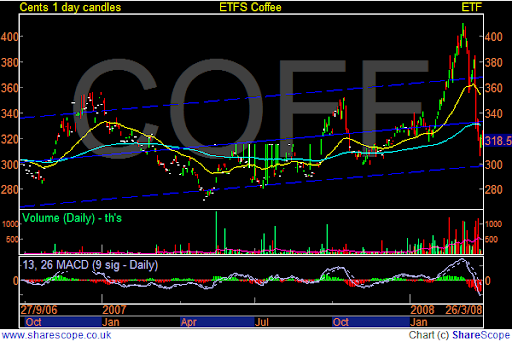
AS I said in my previous posts my personal preference is for Coffee itself and I am looking for an opportune time to buy the Coffee ETF (COFF) which is building a nice base at the moment around the $3.15-$3.20 area.


Best Wishes


Alan

Tuesday, 22 April 2008

Investing in Brazil

Brazil_-_Rio_de_Janeiro

A few Years ago Morgan Stanley came up with the original idea that four big countries – Brazil, Russia, India and China – would together soon become so important in the world economy that they could be viewed as a single group, much as we think of Europe or Latin America.

They dubbed the group BRIC, after the first letters of their names, saying that their combined economies, from being just 15 per cent the size of the world’s six most advanced countries’ – including the US and Japan -- would grow to become even larger than them in combination in fewer than 40 years.

There has been a lot of focus on India and China and I have written about these countries in past articles Broken China ??   &  Investing in India The challenge with both these countries is that they do seem to still be linked to the fortunes of Wall Street and have suffered along with the US Markets

Brazil and Russia, by contrast, are among the handful of countries best situated to supply those increasingly valuable natural resources and so are fairing a lot better and seem less exposed to the US story and more exposed to the Commodities and Energy story that is doing well in the face of the US recession.

Russia is a huge exporter of oil and natural gas, nickel and platinum group metals. Brazil is the world’s biggest supplier of internationally-traded agricultural products such as sugar, soybeans, coffee, corn, orange juice, beef and poultry.

                                          Cooldown

Both still have enormous resources that can be developed to meet Asia’s growing demands.


No shortages of energy, food or water

Last year Brazil’s main stockmarket index rose 71 per cent in US dollar terms, or even faster than India’s, suggesting that international investors are awakening to the potential of the South American giant.

Much of that interest was focused on Brazil’s two biggest stocks – Vale (NYSE:RIO) and Petrobras (NYSE:PZE). Vale is the world’s biggest exporter of iron ore; Petrobras has just made the world’s second-largest oil/gas discovery in 20 years, deep beneath Atlantic waters.

But it’s renewable resources, rather than minerals, that are increasingly attracting investor interest.

The well-known British investor, Jim Slater, says Brazil is “insulated against the world’s main shortages – fresh water, agricultural commodities and energy.”

It contains nearly a fifth of the world’s fresh water, available to expand agricultural production and carbon-free electricity generation. Hydro-power already provides 80 per cent of Brazil’s electricity needs, and two big new dams are being built on the Amazon at a cost of $10 billion.

Because it can produce alcohol fuel from sugarcane, without subsidies, for prices competitive with petrol, Brazil has been dubbed “the Saudi-Arabia of ethanol.”

David Fuller, the London-based analyst, says: “No country is better positioned to benefit from the agricultural boom than Brazil, with its large and fertile land mass, absence of any desertification, and ample supply of fresh water.”

Other commentators point to the nation’s economic growth rate (around 5 per cent a year), a foreign trade surplus (running at about $40 billion a year), large foreign reserves, a strong currency and a buoyant stock market.

Last year Brazil attracted FDI (foreign direct investment in factories and business operations) of $37 billion, or twice as much as India. It was the world’s third biggest raiser of investment capital via equity issues after the US and China. And its international bonds are expected to be granted investment-grade status within two years.

Brazil has a flourishing middle class of 20 million – depending how you define “middle class,” five times larger than India’s – as well as political stability, a favourable environment for foreign investment, and strong job creation (5 million new jobs since 2000).

Years of favourable international environment, combined with good policies such as more disciplined public finances and trade liberalization, have delivered low inflation and falling interest rates. One result is the emergence from poverty of a new lower-middle class, so the nation’s notorious income inequality has been declining.

Sensitive to foreign capital flows

What are the negatives?

The public sector is bloated and corrupt, packed with time-servers with jobs for life and fat pensions to look forward to. Taxes to pay for it gobble up more than a third of national output – a proportion much higher than in other emerging markets and out of proportion to the low quality of services provided.

As is commonplace in countries where planning, building and operating infrastructure is almost entirely in the hands of bureaucrats, Brazil has some serious infrastructural problems, including power-supply shortages. The regulatory environment is not sufficiently clear to attract private investment.

Labour laws are highly restrictive, with welfare and other compulsory contributions adding 60 to 100 per cent to employers’ payrolls.

The stockmarket is very sensitive to flows of foreign capital, therefore exposed to adverse money shifts that may be triggered by developments unconnected with conditions in Brazil itself, such as the US sub-prime crisis.

Finally, remember that although Goldman Sachs’ BRIC study projected good per capita growth rates for the Brazilian economy over the coming decades, it suggested the three other nations in the group would grow even faster.

If you are interested in adding Brazil to your international portfolio to provide balance, the best way to do so is probably via one of the exchange traded funds listed in London or New York. There is an iShares MSCI Brazil Fund in London which I would favour as it is priced in Sterling and not Dollars or there  is the Brazil Fund (BZF) that trades in new York if you are looking for a dollar denominated fund.

IBZL

               Best wishes


Alan

Wednesday, 26 March 2008

Should I buy Coffee ?

In the last part of this series I will look at the final piece of the puzzle of whether to buy Coffee or Starbucks by talking about the Coffee ETF (COFF).

We can see from the chart below that coffee has dropped off fairly sharply from the recent highs but seems to be forming a base around the 320 mark :

COFF 

The stock to use ratio of coffee has been pretty low compared to where it has been in the last two decades this would indicate that we should be seeing prices being supported at least and probably moving higher.Coffee is being increasingly drunk throughout the world and the rising affluence of the emerging markets middle classes is likely to see an increase in their coffee consumption as the big chains start to open franchises and people look to emulate what they see in coffee drinking as a sign of western affluence.


In one of the biggest emerging markets I.e. China, the consumption of coffee is on the rise .It’s been estimated that China’s coffee consumption was approximately 45,000 tons in 2006. But that number could jump five-fold or even six-fold to reach 300,000 tons annually in the next 10 years. China's coffee consumption is growing at rate of 10% to 15% each year. And with a population of 1.3 billion, it won’t be long before China becomes the No. 2 coffee consumer in the world.


I believe that the medium term outlook for coffee is very positive, it is however very volatile and reacts violently to changes in weather, for that reason I would steer away from the Futures market, however the ETF is not leveraged so will allow you to stay in for the long term and not worry too much about volatility.

I would like to see it building a bit of a base here then moving higher and I would be buying with a longer term view for my Pension. I would likely leg in to the position a third at a time and place a 25% stop loss.

So to answer the question, would I buy coffee or Starbucks ? For me personally where there is an option to buy into the commodity I would always favour the commodity as it is less susceptible to other forces beyond supply and demand Stocks can still suffer due to poor management or with the market in general, this is less likely with the commodity so I will be buying Coffee and not Starbucks.

I like coffee for the longer term and will buy the ETF when I see the price moving back up again from here.


I would be interested in your views: Coffee or Starbucks ?


Best Wishes


Alan

Monday, 24 March 2008

Should I buy Starbucks

In my last post I asked the question re buying Starbucks or the Coffee ETF, I will look today at the Bear and Bull scenarios for Starbucks (SBUX) and my next post will look at Coffee (COFF).At the beginning of this year The chairman of Starbucks -Howard Schultz took back the reins as CEO. The idea being that he help the chain out of its recent slump.The stock has fallen over 45% in the last 12  months and recently was trading down near 4 year lows .The main concerns were that the chain has overexpanded and was suffering from major competition.The economic slowdown may also make people think twice about the cost of that Double tall Skinny Mocha on their way to work every day.


Bear Case

The vast amount of the growth in Starbucks was from adding new stores, but there comes a point when this is not going to be the best way of generating future revenues and profits, particularly as margins have declined in line with increased labour and rent costs.There is also increasing competition from the fast food chains such as McDonalds. In the short term Starbucks has to do something about its profitability and investing in new stores may not be the best way of doing this , sure Howard Schultz built the brand from the early days but a major slowdown in the economy is going to really hurt in this sort of industry.It may be a real challenge for them recovering particularly  in the teeth of a recession


Bull Case

Currently Starbucks shares are trading at a historic low for Forward Earnings. Howard Schultz is probably the best placed person to engineer a turnaround, he has the experience to know what the organisation needs to do to be able to turn the current position round. They currently have around 11,000 stores in the US and have cut back dramatically on planned store openings  with less than 1000 planned for 2009.They re looking to expand internationally where the growth potential is much higher than in the US.Longer term they may actually be able to get back on track.


In my next post I will look at the situation for Coffee and then give you my verdict .


Best Wishes


Alan


Technorati Tags: ,,,

Friday, 21 March 2008

Should I buy Coffee or Starbucks ?

Having just got back from a work trip I was sitting in the airports(as seems to be happening more and more often) with my Cafe Latte and Double chocolate chip muffin-which had cost about £5 ($10) and reflected on how busy it was with not a spare seat to be found. being a regular coffee drinker, I started to wonder on the best way to invest in my favourite beverage.I have traded futures before and coffee can be one of the most volatile with violent weather related swings-it is definitely not for the faint hearted. So over the next couple of days I am going to look at the outlook for Starbucks and also at ways that you can invest in coffee without having to get involved in the highly leveraged and often manipulated futures markets.

We will see that Starbucks is not necessarily correlated with the price of Coffee, as with all commodities versus shares that are related to or have an interest in commodities there are many things that come in to play that can impact a share like management costs etc that do not affect the prices of a commodity which are driven mainly by the fundamentals of supply and demand, this makes them easier to predict over the medium term.

In my next post I will look at Starbucks and in the post after that the Coffee ETF.


Best Wishes


Alan

Monday, 17 March 2008

Things You Can Buy For $2

The markets got hammered at the opening on the news that JP Morgan had bought Bear Stearns, they are off their lows for the moment but  the DJI hit a low of 11756 and the futures hit 11671 before rebounding, Gold hit a record of $1030 an ounce but is currently trading at $1006. People are running for the Hills. it will be interesting to see what comes out this week with the FOMC statement on the 18th.Already the Fed has cut the lending rate for institutions from 3.5% to 3.25%. This increases the likelihood of another large cut  at the next Fed  meeting there is some talk of a full 1%-that to me really smacks of panic .It is also reported in the UK Sunday Telegraph that Goldman Sachs  will report a $3 billion write down when they report on Tuesday, so it seems even the previously untouchable Goldman have got their fingers burnt as well. Unfortunately I think there is a way to go with this before we see the bottom, but only time will tell.


Precious Metals and Commodities, it is becoming a mantra but there is nowhere else(apart from Cash) that looks likely to be reasonable in the next 12-18mths until the stock market has dealt with all the issues and found a bottom.


On a slightly lighter note I found this article   on another blog, and found it amusing but also very telling about the state of the Financial Institutions, it is  worth noting that not that long ago Bebo the social networking site was sold for $850 million -more than 3 times what Bear Stearns was deemed to be worth. Interestingly the Fed has also underwritten the purchase of Bear Stearns, so similarly to the debacle in the UK of Northern Rock it is the American Taxpayers that are in hock for the approx. $30billion of "Toxic Waste "  that has caused the decline of Bear Stearns, when you consider back in September Bear Stearns was trading for around $100 that is one hell of a discount .


 Things You Can Buy For $2

Things you can buy for $2:

  • 2 limes
  • 1 organic avocado
  • 15% of a drink at a bar
  • A pound (sterling)
  • A day’s worth of labour from a farmer in the Indian countryside
  • Nothing at a strip club
  • A payoff of that persistent newspaper boy who wants his $2
  • 2.3 cheeseburgers from McDonald’s
  • Medicine for an African child for a whole month
  • Oh yeah and these guys….

Amazing Bear Stearns (NYSE: BSC) Fact: Their building is worth 3x more than what their equity was sold for.

Best Wishes


Alan


Thursday, 13 March 2008

Gold hits $1000, Retail Sales Decline-Paulson says a Strong Dollar is very much in the US interest-yea right !!


Well it happened even quicker than I thought but Gold hit the $1000 mark earlier today although it has since backed off slightly, Retail sales numbers disappointed again ,dropping 0.6% versus expectations of a rise of 0.2-0.3%.This has had an impact on the major Indices with the DJI down 185 points at the moment just off the days lows.


Hank Paulson is currently speaking and saying the same old mantra of how a Strong Dollar is in the US interests, only a couple of days after "helicopter Ben" scatted another $200 Billion dollars in to the markets like confetti, not quite sure how that will help a strong dollar.but hey how would I know. It looks like the engine of US growth the consumer may be finally drawing in its horns amongst the pressures form the Credit Crunch and Housing.If they continue to spend less and less this will really start to create big problems. With oil hovering around $110 and gas prices going through the roof, who can blame folks for not getting in their car and driving to the mall to send more ?


I am staying long and strong Precious Metals and Commodities, my position in PHPM (Precious Metals ETF) is up 51% on an annualised basis, DBA (Agriculture ETF) is up 186.9% annualised and the cotton ETF is up 235% annualised. Now is not the time to be buying stocks especially in Retail, or Financial's.


Best Wishes


Alan

Stocks decline after record Rise yesterday-Gold moving towards $1000

As I mentioned in my earlier post, I really don't feel that yesterdays rise was anything other than a massage upwards based on the Fed's announcement of a $200 Billion injection to improve liquidity.Today after rising at the open we worked our way back to end up with declines across the board.

The Dow Jones industrial average (INDU) lost 0.4%, the broader Standard & Poor's 500 (SPX) index lost 0.9% and the Nasdaq composite (COMP) lost 0.5%.


The announcement of the injection of capital from the Fed sparked a short covering rally but today we returned to concerns about what the economy is doing .The Retail Sales numbers are due out on Thursday and they will be closely watched to see what consumers are doing, if we see further declines in retails sales then it will likely spark another moving lower of the indices.


Oil hit an all time high above $110 a barrel before closing just below that, I can well remember the raised eyebrows when Goldman Sachs forecast $100 by 2009 in July 2007. looks like they were dead wrong and we got there a lot sooner !!


For me Commodities are still the place to be at least in the medium term, sure we will see pullbacks, some of them vicious but I do not see them being a bad investment over a 2-3 yr horizon.Gold was up again at $985 and I don't think it will take much for us to see $1000 in the next couple of weeks.


Best Wishes


Alan


Wednesday, 12 March 2008

Is the worst over ?-Should we Start Buying Stocks again ?

Yesterday there was a huge rally in the stock markets, Look at the 5 minute Intraday chart below:


DJI


The markets continued higher at the outset today but with little conviction and already at the time of writing, the DJI is 100 points off its high. My own view is that we are seeing bounces inspired by well orchestrated news releases and manipulation by the Fed and others to stop the  markets plunging.I am sure a lot of you have heard or read about the PPT(Plunge Protection Team) Plunge Protection Team  who's role is to try to stop catastrophic drops in the market by intervening when appropriate.A lot of people feel that there role has now morphed and they are intervening far more often in the markets to maintain the perception of a strong economy and a bull market.  There has been a number of press articles lately indicating that they are back in the markets Bush convenes Plunge Protection Team. I think we will see them being increasingly less and less effective as time goes on and people realise that there is no real substance to these rallies only manipulation. For myself I am sticking to Precious metals and Commodities as I have been advocating of late. I do not think we are out of the woods yet and there are definitely still a few hungry bears roaming around in the Bushes.


What are your views, should we be buying stocks again, is the PPT a good thing or is it getting in the road of market forces.


Best Wishes


Alan

Thursday, 6 March 2008

How to make Money from Higher Food Prices

I am sure like me, that you have noticed the increased prices of many food stuffs when you make your trips to the local store or supermarket.Global food scarcity is even in this day and age still a major problem.Countries such as Egypt have actually widened its food rationing system for the first time in 20 years.Russia and China are putting controls in place and other countries such as Vietnam are imposing taxes on foreign sales to protect their own supplies.

The cause of all this is that our current Global food supplies cannot cope with the increasing demands of a world population which is growing by over 70 million per annum.Not only is that a huge increase but the emerging market countries with their expanding middle classes are starting to demand Westernised , meat heavy diets.We are also seeing misguided political pressure to increase the use of Biofuels-this has the effect of diverting already stretched supplies of foodstuffs such as grains to energy inefficient fuels.

This means that over the last year while the price of agricultural commodities have gone through the roof look at the price of wheat over the same period.

WEAT

Last week the price of wheat rose 25% in one day as Kazakhstan (one of the largest exporters of grain) announced a plan to impose export tariffs.This caused buyers to panic sending the price soaring.So we all pile into grains then?...well not exactly I am always wary when something moves this much so quickly and I think we are experiencing a short term bubble in the price of grains.

For me a better way to take advantage of the grains boom and one which is not so obvious-and therefore less likely to be driven up by the hype is through buying meat such as Live Cattle and Hogs.Normally this would only

be possible on the CME futures but once again the advent of ETF's or in this case ETC(Exchange Traded Commodities) come to our rescue.

They can be traded in London via ETF Securities the symbols are( LSE:HOGS) and (LSE:CATL). This will give in my opinion good exposure to the grains boom-how I hear you ask, well Livestock are fed mainly on grains so if you are a livestock farmer faced with the choice of paying the increased costs of feeding your herd or selling them in the market-it seems to be a pretty easy choice.The farmers rather than feed their livestock grain will sell it into the market and obtain record prices, they will then also sell the livestock.

If you look at the prices of cattle for the last 12 months you will see that cattle has dropped in price as a result of too much stock hitting the markets

CATL

This will mean in the near term we have too much grains everyone is planting that to cash in on the high prices and not enough meat, within the next 6-12 mths people are going to start to realise that there is a shortage of meat and this will I believe cause prices to rise. Supply and demand, Supply and demand the mantra on which the commodity markets thrive.

I would be looking for opportunities to cash in on the grains and buy the meats.If you feel really aggressive then think of going short the grains and long the meats....how can I do that in a non margin account I hear you ask...........well that is for the next post. Until then good trading.

Alan


Reference List

href="http://traderbill.wordpress.com/2008/03/03/3308a-mess-and-a-half/" rel="nofollow">3/3/08…a mess and a half « Traderbill’s Financial Markets..

Bull Market in Agriculture | Teach Talk Trade Day Trading & Technical Analy..

The value of the U.S. dollar is sinking world-wide. « Bridges to Hope..

Wheat’s Major Price Reversal : Contrarian Profits

Data Feed « Trading for the Masses

Now That Warren Buffett is Crazy About the Loonie, Here are Seven Ways to P..

Tracey’s Market Update : Blog Archive : Wheat: “A rally of e..

Putting the pieces together...: Commodity/Inflation Funds: Update

Tuesday, 19 February 2008

Commodities -How to invest without using Futures or Leverage

In the last month the volatility in the stock market has been greater than it has been for some time, we have seen three figure up and down days regularly.  In an environment such as this it is easy to understand why some people lose sight of the macro environment.  If we look at what is actually happening in the world then it becomes a bit more obvious the the areas we could consider investing in.  One investment area that has been consistently on the up over the last few years is commodities.


Most commodities have performed extremely well over the last few years, the obvious ones like the precious metals we are fully aware of, some of the less well known is commodities are also doing extremely well.  The question is can we take advantage of these also. For many years I traded commodity futures this is definitely not a market for the fainthearted, but until recently was the only way that most people could invest in things such as Corn, Wheat, Cotton and Coffee. In the last little while however ETF's that invest in these commodities have become available.  It is now possible to buy, ETF's that follow the price of individual commodities such as the ones I have mentioned earlier, in fact ETFS securities in London allow you to buy ETF's that track pretty much any commodity that is traded on the futures exchanges including things such as Live Cattle and Pork Bellies.

With the increasing affluence in countries such as India and China we are seeing unprecedented command for all commodities, not just the Base metals for construction and infrastructure but foodstuffs such as sugar , and wheat.The demands being placed on these crops are such that we are starting to experience real pricing pressure on a lot of our staple foodstuffs.This pressure is unlikely to go away and in fact is likely to increase as these markets demand more and more of the types of food we eat and take fro granted in the west e.g. Chocolate, Refined sugar products breakfast cereals etc.An other pressure on crops such as corn will be the increased demand for meat and poultry, it takes a lot of corn to feed livestock and as demand for meat products increases then there will be a subsequent demand for feed for them.

One of the best performing ETF's this year is the Powershares Agriculture ETF (DBA ) it is up around 30% this year already


 DBA


This trend is likely to continue for a good while yet as the demand for agricultural commodities is far outweighing the supply, I recently bought the DBA again(the Green B on the chart) and intend to hold it for the longer term.The other ETF's that I like are in Cotton (CTN) Sugar (SUGA) and Coffee (COFF). Coffee and Sugar have run up quite fast of late so I am waiting for a pullback to enter these but have recently added the cotton ETF as I think we may see Cotton breaking out sometime soon.

I will talk in a bit more detail about some of the other ETF's that are available in Oil etc in a subsequent posting, but if you are not too keen on trying to pick an individual commodity there are some good baskets that you can look at DBA is one as is AIGG (Grains) AIGS (Soft's-Sugar, Cocoa etc). Another very interesting basket to look at is the Rogers Commodity Index, which is a basket of commodities that tracks picks from Jim Rogers of Quantum Fund fame, Jim has been singing the praises of commodities for many years now and as in the past has proved to be very accurate in predicting Macro trends to invest in.The table below outlines what is contained in the RJI Index and the percentages of each commodity it holds.


clip_image001


This will give you a broad exposure to pretty much all commodities and is a great way to gain exposure to these markets, Jim reckons we are still only midway through this commodity bull cycle and sees another 5+ years or so before we risk reaching a top.This could be one to add to your portfolio and top up  pullbacks. Certainly I am of view that in the 2-3 years most if not all commodities are likely to definitely outperform the stock markets and also probably prove less volatile. I currently am holding a lot in the commodity sector and will be adding to my holdings on weakness.


If you want to learn more about Jim Rogers views on the markets I highly recommend any of these books he has written, they are not only highly informative but also a good and easy read.


Good Trading


Alan


Agriculture, natural hedges and BRICs « Abnormal Returns

PowerShares DB Agriculture ETF Forced to Buy Alternative Futures at What ar..

Now That Warren Buffett is Crazy About the Loonie, Here are Seven Ways to P..

Eric Roseman's Eruptions: Stocks, Global Markets and Commodities BLOG: Comm..

ETF$U » Blog Archive » Well Lookee, lookee here

Toro's Running of the Bulls Market Blog: Agricultural Commodities

Tuesday, 23 January 2007

How to Make Money in Agricultural Commodities


The above are weekly graphs of Corn, Wheat and Soybeans,as you can see since the last quarter of 2006 these have been making new highs and in fact corn has hit over $4 a bushel, this is the first time since 1996 that this has happened.


Jim Rogers one of the most succesful commodity bulls of the last 30 years has been quoted on many occasions stating that the so called "Soft" Commodites are where he sees the big growth in the next 5-10 years.Everyone is familiar with the energy and precious metal stories , but agricultural commodities are not really something that many people outside of the CBOT(Chicago Board of Trade) have much to do with.This plays in to our hands, the big money is to be made buying in to these areas before we start hearing about it on CNBC and the Wall Street Journal.Jim was telling anyone who would listen about Oil and Gold around two or three years before they really took off and became big news.We want to be in these for the next few yeasr then be selling to the masses when everyone is talking about them.


Ads by AdGenta.com


One of the major challenges surrounding these assets was unless you were willing or able to trade Commodity Futures there was little or no opportunity to play these markets directly.I personally do trade Commodity Futures ..and they are not for the faint hearted,but they were the only direct way to play these markets up till now.


On Friday the 12th of January for the first time ever investors could buy Agricultural Products through the stock market...Powershares launched an agricultural ETF (NYSE: DBA).


This new fund tracks an index which is divided equally among wheat , corn, sugar and soybeans it is run by Deutsche Bank. There are many reasons why these commodities will I believe go much higher the main ones are :


  1. Agriculture has been in a bear market for many years....it is now showing signs of breaking out.

  2. A lot of the rationale for this can be placed at the door of higher energy costs, these commodities are used in the manufacture of alternative sources of fuel such as Ethanol-(it is rumoured that Ethanol will be given a big push by President Bush in the State of The Union address tomorrow night.)

  3. China is importing more and more of these products and they are soaking up the supplies faster than ever before.

  4. Lastly the USDA revised downwards its estimates on these commodities so there is likely to be less around than previously envisaged.


I like the agricultural commodity story and will be taking a position in the Powershares Agriculture Fund (NYSE:DBA) .I would be looking to hold this for a good few years and will look for opportunities to add to it on pullbacks.


My recommendation would be to scale in to it so if you are looking to own say 500 shares then buy 300 now and look for opportunites to add another 100 and then another 100 when we get some price weakness.


I will place a 25% trailing stop loss against my position.


The website for the DBA is http://www.dbfunds.db.com/dba/index.aspx


Best Wishes and Good Trading


RT


Powered by Qumana

Monday, 22 January 2007

Portfolio Performance Curves


 Well at last I have sorted out some problems I was having with some of my software and can now post my equity curves for my US and GBP Pension Fund Holding showing performance since May 2005 when I started.
The GBP portfolio(Lower Graph) is showing the best returns compared to the US holdings.The GBP portfolio is solely made up of stocks which I have been holding for 6-18 mths  as long as they do not hit my StopLoss.I think if you click on the charts they will open larger in your browser(well they do in mine)

The US portfolio is a bit more aggresive and uses Options as well as having a trading apporach.It will be interesting to see how they perform and whether one method consistently beats the other.For now I am happy that they are both showing returns that would outstrip what you would get from having them managed by the "Professionals" which was the whole reason for me doing this.

The performance is down from where it was last May-when the bottom fell out of the Commodities market, since I am a Commodities Bull my portfolio was (and still is) more weighted to the commodity and resource stocks so has suffered a bit for that.
I will post these graphs on an approximately Monthly basis to show how I am doing.

Best Wishes

RT