How to make Money in the Stock Market.This blog looks at how you can make money trading and investing in Forex, Stocks Options and Futures.

Google

Tuesday, 6 May 2008

$200 Crude Oil-surely not ?

  It wasn't that long ago that Goldman Sachs printed the "crazy prediction that Crude oil would reach over $100 a barrel .well they are at it again and who would dare doubt them this time. The story below from Bloomberg quotes the analyst behind that earlier prediction Arjun Murti as saying that within two years we could be seeing oil hitting between $150 and $200 a barrel. I wrote about Peak Oil and its impact in this article Has Oil Peaked ?Gas Flare Oil Rig

Based on this prediction it most definitely looks like there is a growing acceptance(unless you are a Politician or in Saudi Arabia) that we may actually be running out of oil. If this prediction comes true (like the last one did) then it really will have some ramifications for the world economy and possibly also stability.


May 6 (Bloomberg) -- Crude oil may rise to between $150 and $200 a barrel within two years as growth in supply fails to keep pace with increased demand from developing nations, Goldman Sachs Group Inc. analysts led by Arjun N. Murti said in a report.

The price of crude traded in New York averaged $56.71 in 2005, $66.23 in 2006 and $72.36 in 2007. Oil rose to an intraday record $120.93 today on speculation demand will rise during the peak U.S. summer driving season.

``The possibility of $150-$200 per barrel seems increasingly likely over the next six-24 months, though predicting the ultimate peak in oil prices as well as the remaining duration of the upcycle remains a major uncertainty,'' the Goldman analysts wrote in the report dated May 5.

A report yesterday showed U.S. service industries expanded in April, signaling higher energy use. The Institute for Supply Management said its index of non-manufacturing businesses, which make up almost 90 percent of the economy, grew for the first time since December. China is increasing refining capacity and boosting imports to meet rising demand for the Olympic Games.

U.S. gasoline demand typically climbs going into the summer season when Americans take to the highways for vacations. The peak-consumption period lasts from the Memorial Day weekend in late May to Labor Day in early September. Monthly fuel sales were the highest during August in five of the last six years, according to data from the Department of Energy.

China Consumption

China, the world's fastest-growing major economy, has more than doubled oil use since New York crude oil dropped to this decade's low of $16.70 a barrel on Nov. 19, 2001. Record prices have failed to stem rising consumption in developing nations, with demand led by China, India and the Middle East.

Price forecasts for spot U.S. benchmark West Texas Intermediate crude oil for 2008 to 2011 were revised higher by Goldman. The 2008 price estimate was raised to $108 a barrel from $96, the 2009 forecast to $110 from $105, and 2010 to 2011 estimates are projected at $120 from $110, the analysts said, citing slowing supply growth in Mexico and Russia, and low spare production capacity in OPEC.

Oil has also rallied amid a dispute between the U.S. and Iran regarding the Persian Gulf oil producer's plan to develop nuclear energy.

In Nigeria, Africa's biggest oil exporter, militants have attacked oil installations and kidnapped workers since the beginning of 2006, forcing Royal Dutch Shell Plc to halt output.

Venezuela Slump

In Venezuela, production has slumped to about 2.34 million barrels a day from almost 3 million barrels a day in 2002, according to Bloomberg's estimates, before President Hugo Chavez fired almost 20,000 workers who had closed the state oil company in an attempt to overthrow the government. well
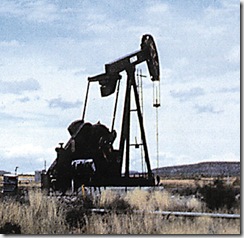
Iraq's oil production has yet to reach levels attained before the U.S.-led invasion of 2003 as the country struggles with sectarian fighting and attacks on its energy infrastructure.

Mexico's production has fallen below 3 million barrels a day since October as Petroleos Mexicanos, the state-owned oil company, failed to compensate for a 30 percent drop at Cantarell, its largest field, which accounts for 40 percent of output.

``There are supply constraints with many producers, especially from non-OPEC struggling to find new reserves and China and Middle East demand keeps growing,'' said Victor Shum, senior principal at energy consultant Purvin & Gertz Inc. in Singapore. ``The fundamentals are prompting investors to get into oil in a big way and all that points to higher prices.''

OPEC Capacity

Spare production capacity of the Organization of Petroleum Exporting Countries is low and the group's exports may fall because of ``lackluster'' supply growth and rising domestic consumption in member countries, the Goldman analysts said.

``Non-OPEC supply is struggling to grow, with notable declines being seen in Mexico and Russia showing signs of rolling over following an extended period of rapid growth,'' said the analysts from Goldman, the world's biggest securities firm by market value.

Prices are also poised to gain as major oil-exporting countries restrict foreign investments, limiting supply growth, while demand from developing countries, or ``non-OECD'' nations is rising on economic expansion and power shortages, prompting higher demand for gasoil and fuel oil, the Goldman analysts said.

Crude oil for June delivery was trading at $120.47 a barrel, up 50 cents, at 8:42 a.m. in London in after-hours trading on the New York Mercantile Exchange. Yesterday, futures closed 3.1 percent up at $119.97 a barrel, the highest closing price since trading began in 1983.

`Super-Spike'

``The core of our super-spike view has been that a lack of adequate supply growth coupled with price-insulated non-OECD demand growth'' is leading to higher prices, the analysts said. That could result in a ``sharp correction in oil demand,'' the Goldman analysts said.

Crude oil's increase above $100 a barrel was partly because of the dollar's decline against the euro, which boosted oil prices because it made commodities cheaper for buyers outside the U.S. and attracted investors as a hedge against inflation. Oil in New York touched $100 a barrel on Jan. 2.

The U.S. currency has declined 5.4 percent against the euro so far this year, and 11 percent last year.

Members of OPEC, which supplies about 40 percent of the world's oil, have said supplies are adequate and blamed speculators for pushing prices up to records. The producer group won't consider raising output before it meets in September as the market is well supplied, Qatari Oil Minister Abdullah al-Attiyah said on May 2.

There's a fundamental misperception that so-called speculators are driving prices to unjustified levels, the Goldman analysts said. ``Unfortunately, we do not think the energy crisis will be solved by finding and punishing the big bad speculator.''

Commodity investors, the Goldman analysts wrote, are ``helping to solve the energy crisis'' by speeding up the process for oil companies to spend more on energy projects and at the same time encourage efficiency.

Bloomberg.com: Worldwide


Technorati Tags: ,,

Monday, 5 May 2008

Steel is getting more expensive so invest in Coal

As if most people are not struggling enough with the increases in Gas and Food prices which I wrote about here (Higher Food Prices) but the latest blow comes in the form of increases from the utility companies to the price of your electricity.

In a recent article the Associated Press writes "NEW YORK (AP) — "Consumers struggling with high gas prices, rising food costs and falling home values have something new to worry about: Sharply rising electricity rates due to a surge in coal prices over the past year."

As the article highlights the increase in the price of coal has meant that there have been hikes by the utility companies in the price of Electricity to the end user.One of the main reasons for the increase in coal prices is the demand from emerging countries(yes China again !!)ironworker for coal to fire their increased demand for Steel.

U.S. coal exports jumped 19.2 percent last year, according to the Energy Department, and are expected to rise another 15 percent this year.

"As more of the world develops and uses more energy, and supply tries to keep up with demand, we're going to have these pinch points," said Carol Pfeiffer, director of fuels for the U.S. for utility giant E.On AG.

Coking coal is the type of coal used in steelmaking. Demand from steelmakers is driving prices higher. In fact, many steelmakers, including the world's second-largest producer (Nippon Steel), recently agreed to pay triple what they previously paid for coking coal.


Price of Coal

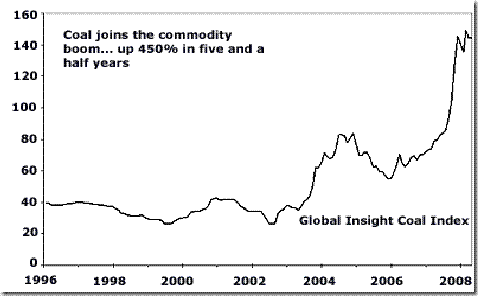
The chart above shows the price of coal over the last five and a half  years up an  450%.The above index doesn't contain any U.S. coal – it's 60% South African, 30% Colombian, and 10% Australian. But the market for coal, like oil, is global. When the price of foreign coal spikes, the U.S. exports more of its coal... resulting in higher U.S. prices.There are a limited number of ways to bet on the price of coal but you can do it mainly through coal stocks... but they are expensive right now.A few of the big names are Peabody (BTU), Consol (CNX), Massey (MEE), and Arch (ACI).

My favourite play would probably be buy a basket of coal producers with the Market Vectors Coal ETF (KOL).Currently prices are high and I would wait for a pullback maybe to around the $43 dollar level at support before considering a purchase. There is no doubt that high energy costs are here to stay whether the cost of our gas in the tank or the price of our electricity one way to mitigate the impact is by buying the companies an sectors that will benefit from us paying them more.


Best Wishes


Alan

Sunday, 4 May 2008

Invest in Water it is the new Oil

I was working recently in Lisbon in Portugal and was talking to some of the locals  about the weather,being from Scotland I was looking forward to some of the Lisbon sunshine and warm temperatures.Unfortunately for the three days that I was there the weather was similar to my native Glasgow- wet and windy. The locals had commented that they had a lot of rain so far this year but not enough to make an impact on water prices.

Now being from Scotland as I mentioned it is strange to me that people pay for water usage-in Scotland we pay a local tax for sewerage and treatment facilities but not the amount of water that we use.What struck me as I thought about it was the wastage that there is in countries like Scotland compared to other countries in the world where water is a much scarcer  commodity. Loch Katrine which supplies most of Glasgow's water has a capacity of approx 64.6 million litres and is regularly topped up by the Scottish Weather. Katrine

Listening to my colleagues in Lisbon I realised that we could do a lot more such as not having the tap running constantly when brushing our teeth and not using running hot water to do dishes .These practices are fairy common in Scotland but in other parts of the world would be considered crazy and wasteful. We are in the privileged position in Scotland( but not all of the UK where some areas do suffer from droughts and water restrictions) of not having to worry about a plentiful supply of clean water.In the rest of the world it is a very different story. The world's immediate need for fresh water remains paramount.

Loch Katrine: Scotland

In China, for example, two out of every three major cities have less water than they need. Cities in northeast China have roughly six years left before they run completely dry.

A recent report on the water situation in China  says up to 300 million people are drinking contaminated water every day, and 190 million are suffering from water related illnesses each year. If air pollution is not controlled, it says, there will be 600,000 premature deaths in urban areas and 20m cases of respiratory illness a year within 15 years.One third of the length of all China's rivers are now "highly polluted" as are 75% of its major lakes and 25% of all its coastal waters. Nearly 30,000 children die from diarrhoea due to polluted water each year

Although China is the world's fourth largest economy, growing 10% a year and closing rapidly on the US, Japan and Germany, its environmental standards are often closer to those in some of the poorest countries in the world, says the report. More than 17,000 towns have no sewage works at all and the human waste from nearly one billion people is barely collected or treated. Nearly 70% of the rural population has no access to safe sanitation.

Songhua River in Harbin China "A majority of the water flowing through China's urban areas is unsuitable for drinking or fishing. Some 300 million people drink contaminated water on a daily basis," says the report.

Although China has tried to improve its air quality, it has not invested enough to keep up with the flood of people to its cities, many of which have some of the worst pollution in the world. The burning of more than 2bn tonnes of the dirtiest coal a year is costing the economy the equivalent of 3-7% of GDP (£8-15bn a year), according to the report. While no specific figure is given for the overall cost of China's pollution, in 2004 it was thought to be in the region of £32bn.

Songhua River in Harbin China

The report estimates that 27% of the landmass of the country is now becoming desertified. Much of the country already suffers from water shortages, but the Chinese Academy of Sciences expects water demand to increase by nearly 50% in the next 40 years. Industry's share of this is expected to grow from 16% to 41%.

Low environmental standards are now making people wary of buying Chinese goods, said Lorents Lorentsen, OECD's environmental director in Beijing yesterday. "If you have a reputation for being a polluted country, then you have a bad trademark abroad. It's very hard to sell pharmaceuticals, to sell food and feed from a country that has a reputation for being polluted," he said.

A lot of westerners, however, take water for granted. We simply turn on the tap and it flows. But that's certainly not the case the world over. And from they way things are looking, that may not be the case here much longer. Lakes around the U.S. are running dry. In the West, we see this happening at Lake Mead. In the East, it's Lake Lanier.

While it may not be traded in Chicago, water is a commodity. When scarce, it's the one commodity even more valuable than oil or gold.So when Big Oil starts pouring money into water rights and alternative energy, we want to pay special attention. We tend to believe that water rights will be valued in this century much as oil rights were in the last.

Companies that invest in cleaning up water I believe will do well in the years to come as the world realises that it has to do more to ensure clean drinking water for all.Countries like China are a huge market for these companies.

VE SCOne of my favourite stocks in this area is Veoila Environment (NYSE:VE)  they are a a world leader in environmental services and stand to do well out of the shortage of clean water in the future.

We can see from the chart that the trend is most definitely up but there has been a pullback since the beginning of the year which may present a good buying opportunity.


Best Wishes


Alan


Thursday, 1 May 2008

Why a Weaker Dollar is good for America

For a long time now we have been exposed to the US President ,Treasury Secretary and various Senators talking about the benefits of a strong Dollar and how that is in the interests of America.This is really all just political rhetoric the reality is somewhat different . $ Sign In its current situation the last thing that the US needs or wants is a strong dollar- but unfortunately it just isn't politically the right thing to say.So why is a weak dollar good for America ?

Well if anyone has been to the US recently or if you are indeed a US citizen you cannot fail to have noticed the increased prevalence of foreign accents that seem to be in every restaurant or store.It seems that America is on sale and the rest of the world is buying. Since 2002 the dollar is down about 25% and the rest of the world is taking advantage .Not only do they flock in their droves to the US to spend their money but it is good for exporters as well who find that demand for their goods increases the more the dollar weakens.

Tourism is a huge industry for the US but not only for attracting foreigners to its shores but as the dollar weakens and it becomes more expensive to go abroad more and more Americans are opting for Disneyland Florida and not Disneyland Paris. Not only does the weaker dollar make it more attractive to vacation there but it also makes it far more attractive for foreign investors -whether it is the huge cash piles of some of the Far East and Middle Eastern Sovereign Wealth funds or someone looking for  a US holiday or retirement homeLog Pile

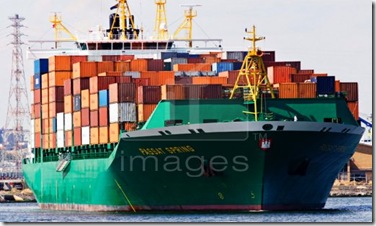
Foreign ventures put $407 billion to work in the U.S. in 2007. That was a 93% increase over 2006. The Chinese, in particular, were an active bunch. Chinese investment soared from only $66 million in 2006 to $9.6 billion last year.American assets should attract even more foreign buyers this year. The Chinese are eyeing American timberlands, for example.  American farmland, mines and other hard assets must also seem cheap.The weak dollar affects things in a couple of ways. On the one hand, it makes imports more expensive. So far, a weak dollar has not stopped imports from growing nationally, though it has slowed the pace. On the other hand, the weak dollar has really benefited America's export engine as I indicated above.Container-Ship-full-load-containers

Exports grew twice as fast as imports in 2007. For the first time since 1995, the gap between the two narrowed. America's commodity producers get a lot of help when the dollar falls. They incur their costs in dollars. Yet they sell into the global market for metals, minerals and other commodities. Global prices are all near multiyear highs, thanks in some measure to the weak purchasing power of the dollar.

America's manufacturers - what's left of them - also gain. Strong demand from overseas drives their sales. Suddenly, America's goods look cheap. "Foreign demand for advanced machinery is huge," reports The Economist. "Civilian aircraft, drilling tools, agricultural machinery and excavators all rose at double-digit rates in 2007."

So in terms of investment opportunities we should be thinking about companies that export a lot of their goods overseas and possibly those in the Hospitality and tourist industries. So no matter what Hank Paulson and his cronies trot out at each press conference the weaker the US dollar gets the more likely they are to be able to find a way out of their current situation and to reduce the Current Account deficit.


Best Wishes

Alan